

“The future of agriculture depends on more than technology. We need to inspire young people, embrace innovation and show that agriculture offers meaningful careers and opportunities to shape the world.”
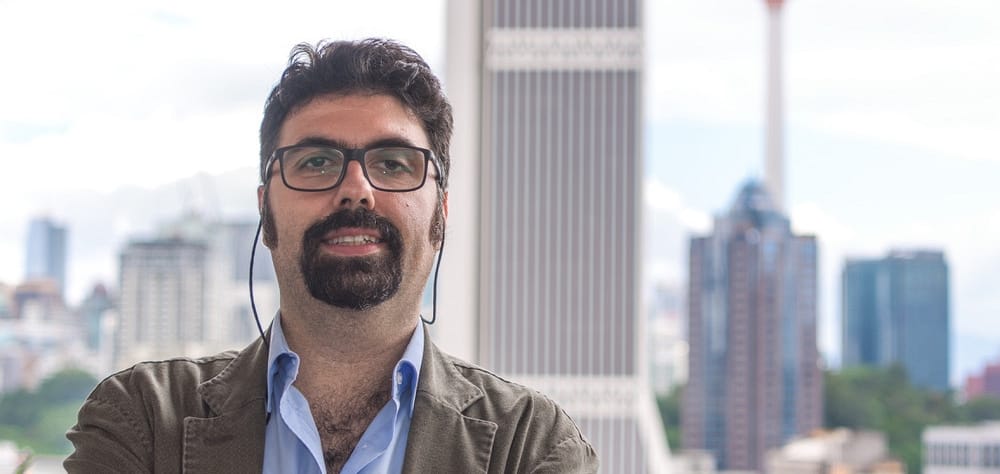
espresso was potent, and so was Dr. Carmelo Ferlito’s thoughts as we talked to him about agriculture and economics in Asia. Born in Italy and finding love in Indonesia, Carmelo now resides in Malaysia where he leads an innovative global company while helming a local economics think tank.
carmelo ferlito - Director Petersime Southeast Asia
One would think that as the Southeast Asia director of one of the world's leading manufacturers of poultry hatcheries and incubators, Carmelo would be hard pressed to find time for anything else. “I am a manager by trade, and an economist by passion.” True enough, his expertise in agriculture and in-depth knowledge on economics enable Carmelo to have distinct views on the markets, sustainable food production, younger talents and advancement of agriculture. “The think tank is a small organisation I created together with my friends. We focus on education with classes on theoretical economics, which includes how a market works. Involvement in Malaysian policy debates and promoting market solutions to policy problems often earns us good local media coverage.”
From your experience, what would be some challenges about market education in Asia?
‘The main challenge is the lack of humanistic education, particularly history. Therefore, economics is considered like a technical discipline, like it’s a set of tools similar to the ones an engineer uses to fix things. That’s wrong, as economics is a way of thinking. Students are very good at all the graphs of supply and demand, but they are not able to understand the historical conditions of time and place. You can’t speak about Adam Smith to people who have no idea of what the industrial revolution was and why the industrial revolution took place in 18th century England, rather than some other place. Students lack the knowledge in history, which is a global problem. I’m a strong advocate of educational reforms, and that we should start from a young age to inculcate students to have a humanistic approach to science. We have generations of young people, very well trained, just like engineers, they’re good in mathematics and physics, but that’s how they look at economics too. For them it’s just a matter of applied formulas. That’s very dangerous, because we are raising generations who think that the problem can be fixed with formulas. No. That doesn’t happen. A true awareness of the complexities surrounding a problem can be developed only by properly studying humanities.’
What is the best way to attract people to agriculture?
‘We must make people understand that a career in agriculture is dignified job, and that there is a high demand for professionals. Agriculture doesn’t necessarily mean you go to the field and spread seeds under the sun. We need to show people that agriculture is something important and meaningful. It doesn’t only mean you get dirty in the field. Nowadays agriculture is more industrial, and it requires technical knowledge, such as in biology and science. Good way to educate people would be to introduce professional high schools with programs for accountants, biologist and junior level engineers in agriculture. The next step would be college, with a focus on specific high-level skills.’
One of the biggest problems is how to attract young people to farming. Is agriculture reserved for the older population?
‘We should bring agriculture closer to students by organising field visits and talks with entrepreneurs that are active in farming. The best approach is to get students involved directly in the agricultural sector, make them see and feel what real farming is about. Otherwise, we get a huge amount of frustrated people coming of college thinking only about jobs in accounting companies, and not understanding the importance of production. It must be made clear and apparent that there are good jobs and career opportunities in productive activities, too.’
As a director of Petersime Southeast Asia, global manufacturer of hatcheries and incubators, what are some new trends in poultry industry?
‘Some coming trends for poultry are less invasive innovations, as well as antibiotic free production. But these trends will take time, as there needs to be a balance between animal welfare and human health. For example, by keeping the chicken antibiotic free, we must make sure that the people in close contact don’t get sick. You can’t just go all-in. A balanced trade-off analysis is always necessary, some matters cannot be solved in an ideological way.’
Could you tell us more about in-ovo sexing technology? Will this new method catch on in Asia?
‘This is a new chick sexing method performed while chicks are still in-ovo, or inside the egg. It was introduced because of the concern with male chicken culling, in the case of laying-hen production. Introduced 3 years ago, it is primarily to avoid culling male chickens at birth because they cannot produce eggs, and genetically unsuited to become meat. The method here is to get them selected and killed before they hatch, which is a far more humane approach. I’m not sure if in-ovo sexing will gain any attraction in Asia, where at the moment, the main concern is still to produce enough quantity at a reasonable price. But the technology is finding research interest in Holland and Germany in particular.’
The poultry sector is one of the fastest growing agricultural sub-sector, especially in developing countries like Malaysia, Philippines, Myanmar, Thailand, Indonesia. Which Asian country is the most advanced in the poultry industry?
‘Thailand is by far the most advanced country in chicken farming, followed by Malaysia, Indonesia, Philippines, Vietnam and Myanmar. Thailand adopted technologies earlier than its neighbouring countries and there are few producers there involved in high level farming with excellent growth prospects. Chicken production is among biggest agricultural sector in Malaysia too, and there are a few farms in Malaysia that are highly automated and self-sufficient. The best technologies from around the world are easily embraced in Malaysia. Pakistan surprisingly deserves a special mention, where poultry entrepreneurs are often those who possess the relevant technical knowledge for farming, as opposed to an investor approach that more commonly prevails in Southeast Asia.’
Which global agricultural trends will shape the economy in Asian countries in near future?
‘First thing that will come here in terms of poultry production will be cage free production. There’s still a way to go, but it’s already becoming popular in Europe, and will be soon common in the United States as well. Poultry producers in Asia will enable at least a part of their production to be cage free. This is to satisfy the demand of the growing number of environmentally concerned individuals, although the superiority of cage-free techniques in terms of animal welfare us still up for debate. Second thing is definitely plant-based food.’
Let’s talk more about plant-based food. It looks like a lot of global food companies are expanding their businesses into the plant-based segment. How will that trend impact the meat industry? And how can the meat producers compete with more sustainable and environmentally friendly plant-based products?
‘The plant-based industry has a future for two reasons, one is the growing number of vegetarians and secondly is the presence of Hinduism and Buddhism in Asia. Being vegetarian is believed to be a healthier lifestyle compared to a meat diet. I generally believe in balance and that we need to eat a little bit of everything. As such, traditional meat producers need to convince people with scientific proof that their product is not being harmful but is equally healthy with high regard to hygiene and health standards. Personally, I feel that a good piece of meat is healthier than non-meat products that has been processed in such a way to taste like meat. In the end, if you choose to be a vegetarian – which is a perfectly legitimate choice – you should not primarily to look for “alternative” meat experiences.’
It seems that more and more consumers are switching to organic meat, vegetables and fruits. What is your opinion about organic products?
‘People often think that if something is organic, it’s good. Just like back in the old days, when we were buying fresh meat, vegetables and diary products from our neighbours in a semi-barter economy. But that’s not what’s happening with organic products. We are often still purchasing organic from big agriculture players, who are just producing the same product in a different way. I believe customers’ perception at this regard matters a lot; certain high-end customers are looking for a certain type of experience in terms of personal believes, although scientifically there may not be a huge difference between organic and non-organic products. It is important to address that these choices are at the prerogative of wealthier consumers, as organic or “animal-friendly” methods of production increase costs. In addition, organic producers recognise that their potential customers are ready to pay a higher premium for their preferences. Often, perception of reality matters more than reality itself.’
You were born in Verona, the Italian city of love, but you found your true love all the way in Indonesia. How did that happen?
‘I was working for an Italian company and travelled frequently to Asia for business. Then in Indonesia, I met my future wife Meilina. We couldn’t think about a future in Italy, because of the low wages and limited social mobility, along with the fact that it is also very difficult for foreigners because of the language barrier. But then, after few months, a job opportunity in Malaysia popped-up, I applied and got the job. We both moved to Malaysia, got married and we started our journey together here.’
So you are from Italy, your wife from Indonesia and you live in Malaysia. Where does your son say he’s from?
‘My son Elio is born in Malaysia and tends to see himself as a Malaysian, although he holds both the Italian and Indonesian passports. At 7 years old, this is the only home he has ever known, and now beginning to understand that there are different people from different countries. He is exposed to much more than I or his Mum were when we were growing up respectively in Italy and Indonesia. I think this experience will make him rich and more understanding of differences but could possibly also affect his sense of belonging. I hope he can go on to take this as an opportunity to become stronger and find his own identity. Nevertheless, he is very conscious of his Italian roots and if you ask me, he is hundred percent Italian when it comes to food. He doesn’t like rice, but he could eat pizza or pasta three times a day. Sometimes he even sips the balance in my cup of espresso. He is a proper Italian.’
Besides Director at Petersime Southeast Asia, Carmelo Ferlito is also Economist and CEO of the Center for Market Education.
Does the idea of living and working in Asia for an extended period of time appeal to you? If so, send us your details so we can consider you for future opportunities or apply for one of the current vacancies on nomilk2day.asia.nl