

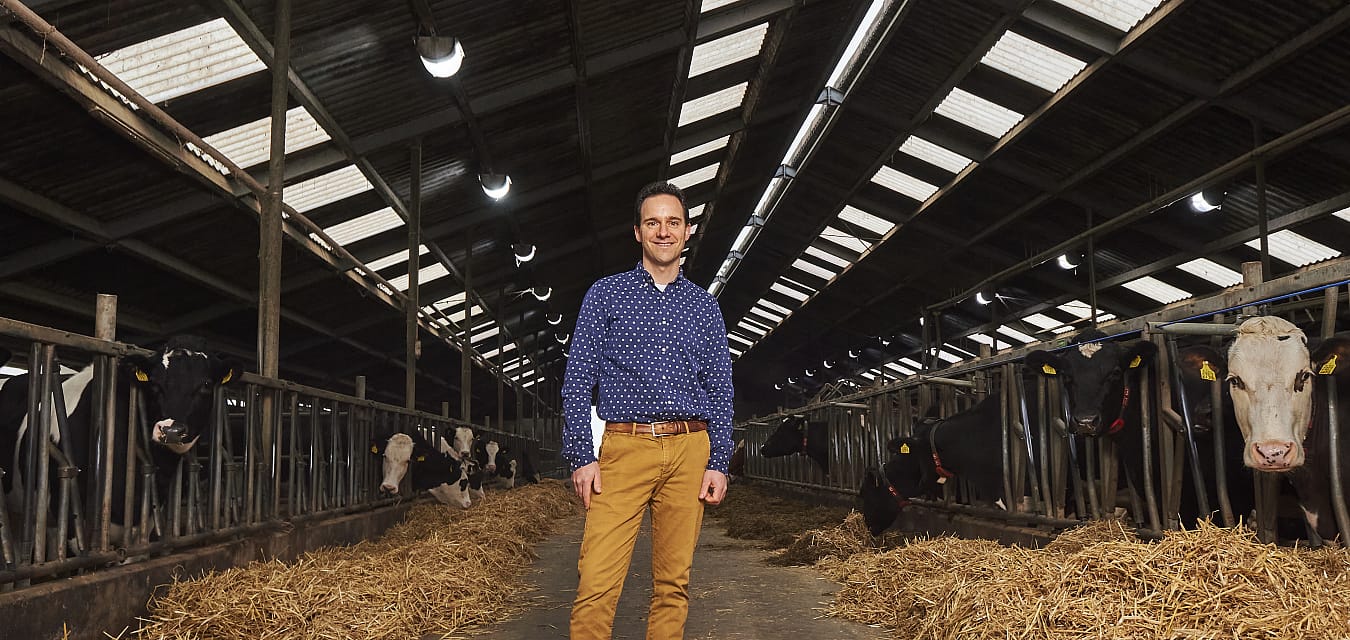
Johan Heeren – Global Digital and Data Science Lead, Agrifirm
Agritech, artificial intelligence, IoT, big data and technology all play a global part in the transition to a sustainable food system. Agrifirm is committed to helping to solve the global food challenge; one of the biggest challenges facing humankind.
johan heeren - Global Digital and Data Science Lead
We don’t really need to ask Johan Heeren from Agrifirm about his ‘why’, that’s pretty obvious. As Global Digital and Data Science Lead, he recently began to build and develop the Digital business unit, along with his team. This team will have an impact not just on the way we produce food around the world, but also on the Agrifirm organisation itself. ‘The tech world is extremely fast-moving and it’s brilliant to be at the forefront of that, creating innovations and being the first to try them out, so that we can introduce them to the market as quickly as possible.’
What is your task?
‘In 2050, there will be almost 10 billion people on the planet; 25% more than there are today. This means that demand for food will be 56% higher than it was in 2010. Today’s agriculture sector would simply not be able to produce enough food for everyone. The answer to the global food challenge is ground-breaking technology. Innovations that help to increase yield while maintaining the same carbon footprint, or ideally reducing it. We discover, test and deliver scalable solutions, which we integrate into our cloud-native platform; described by Microsoft as state of the art.’
What kind of innovations does the platform now offer?
‘I’ll give you a couple of examples. PoultryNEXT: a digital flock-management system that provides poultry farmers with insight into their technical and financial results, which they can then compare with their objectives and the benchmark. Other intelligence applications, such as technical and financial projections, will follow in time. Within arable farming, digital crop plans can be drawn up, in which fertilisation and crop protection recommendations for the growing season are made on the basis of intelligence. For young cattle there is the DairyStart Monitor; a system that monitors the development of young cattle and provides insemination advice, which allows more milk to be produced within the limits of the phosphate ceiling. Very relevant! Finally, there are the feed advice modules for dairy cattle and pigs bred for meat. The solution for dairy cattle even connects to the feed mixer wagon, improving convenience for the farmer, since ingredient lists are available exactly where they are needed. In the future, it will be possible to accurately plan production of roughage on the farm’s own land in line with this, for example. These examples all deliver optimisation of the process at the level of the individual animal on a daily basis. So the aim is to remain relevant for farmers as well as for integration, despite the speed and dynamic nature of digital solutions and intelligence for agriculture in the Netherlands and far beyond.’
All these possibilities sound very exciting!
‘Absolutely. As a frontrunner in the feed industry, the future looks bright. Many products are already “live” and being used successfully, but the expectation is that our efforts will really start to bear fruit over the course of next year. Agrifirm will be increasing its visibility and taking some major steps forward. Take note; it’s all going to happen in 2021. That’s very exciting.’
Is success guaranteed?
‘No, of course not. But that’s the great thing about agritech. It’s not a case of delivering or launching something at the end of a two-year process. We work in sprints lasting just two weeks, over the course of which we determine whether or not a certain component offers value for the market. This allows us to bring new products to the market as quickly as possible. We then continue to improve them while they’re already in use, so that they offer an even better answer to market demand. The key question is always; will this help farmers and other players in the chain to make decisions and take action? And does it contribute to a responsible food chain? Delivering the product straight to the user means that you can test its value together. This working method, based on short cycles, quickly reveals whether it’s a case of “scale” or “fail”.’
So you’re always on top of the latest tools and innovations!
‘That’s right. If something is new to the market, we’re straight on it. Everything changes so quickly within tech and it’s fantastic to see that in action and be the first to try things. That’s the only way to discover whether something is good enough to be added to our platform. It doesn’t matter if a product has been developed by a competitor, for us it’s all about delivering value to farmers and customers quickly. The important thing is that it brings us to solutions for our farmers faster, by allowing better decisions to be taken and therefore better results to be achieved.’
How do you achieve this speed?
‘Most companies in our sector use annual budgets, but we find that working with quarterly budgets helps us to keep up. Changes within technology happen so fast that a quarter feels like a whole year to us. The legislation surrounding phosphate levels is a good example: this changed from one day to the next, so you need to be able to respond straight away. If you work with annual budgets, that’s going to cause problems. Working with short cycles allows you to stay on top of the market. Along with good governance and full business ownership of course.’
Working in sprints, using quarterly budgets, avoiding competition... It’s a different approach.
‘Yes it is. But we want to make a contribution to a more responsible food chain and that’s something you can’t do alone. There is strength to be found in cooperation, connection and tackling issues together. Finding the right partners allows you to achieve real progress. At the moment we’re doing that with and for Agrifirm, but eventually we want to be able to help millions of agriculture businesses, through cooperation. That’s how you make a real difference. It’s what really motivates me! This does require change at a company with a strong history going back 125 years; particularly since our working methods are very different from what our colleagues are used to. They are more agile and highly task-driven, but that’s what fits best with the task we have been set. It’s crucial that we get our colleagues at Agrifirm on board, and keep them on board, by analysing the added value of digital solutions with them but also by demonstrating that value to them. That’s because digital applications and intelligence supports them in setting us apart from other cattle feed or arable farming companies on the market.’
Your team is a new department that works totally differently. Has that had an impact on engagement?
‘We do quite often have to explain to our colleagues what we’re doing and why we’re doing it the way we do, but we have Agrifirm’s full support. Top management gives our department the space and autonomy we need to continue to build Digital. We feel part of the company and our work is appreciated. And at the end of the day we have a shared vision and hence a shared driving force.’
What does the future of digital farming look like for Agrifirm?
‘My hope is that we will be able to make the step to a fully global community. A worldwide farmers community that really works for farmers and food chains, since the platform has developed so much intelligence. That intelligence is what sets you apart. Once that’s in place, you will be able to significantly accelerate sustainable solutions that contribute to the global food chain. That’s how you make the difference in the food challenge.’
What is the underlying revenue model?
‘After the investment phase, this should result in a business model. In fact, I think there’s a chance this could become the new defining business model for Agrifirm. An open-platform model driven by intelligence offers so many possibilities in terms of connectivity, integration and innovation. All focused on added value for the user (!) with the desired impact on the food chain.’
Photo : Robert Westera