

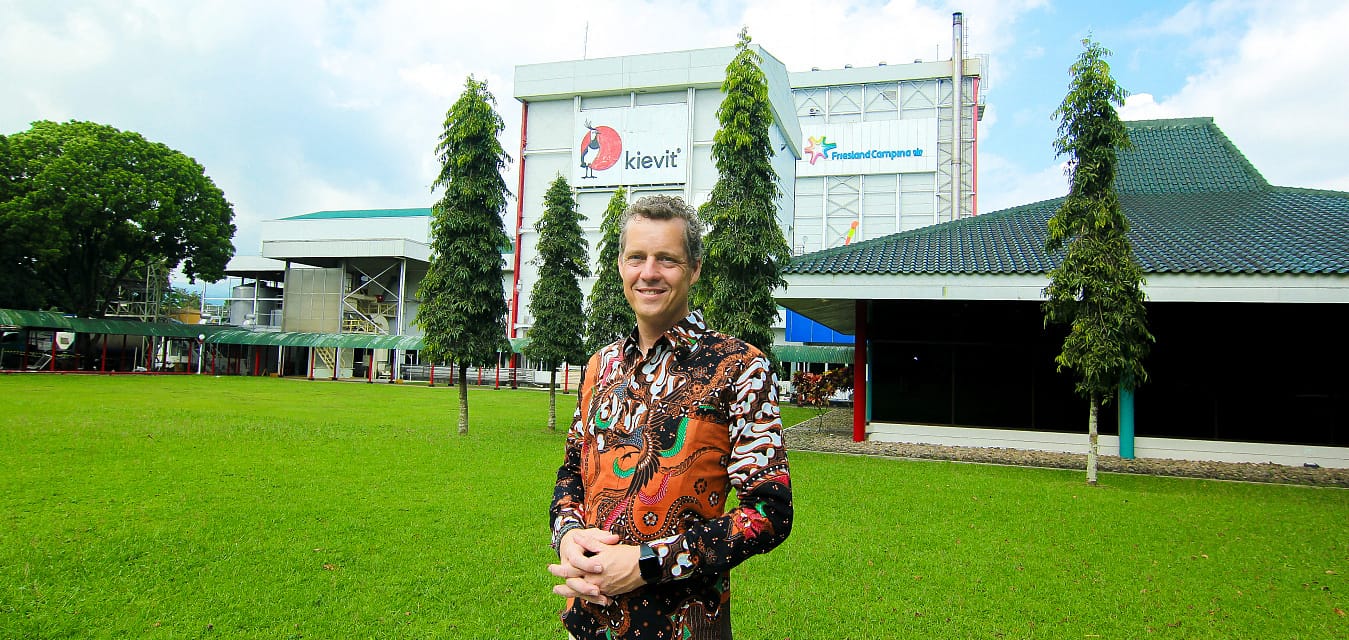
Hans Borsboom – President Director, FrieslandCampina
Also curious about what the life of an expat is like? Then follow us and read an interview every month. With more than four years’ experience at executive level in Asia, Hans Borsboom knows all about living and working in the Far East. ‘It might sound a little crazy, but I enjoy stepping out of my comfort zone. That’s when I learn the most.’
hans borsboom - President Director
Hans was still fairly young when he realized that he would ultimately like to work abroad for an extended period of time. ‘The traineeship in South Africa was definitely the major highlight while studying for my degree in food technology. It was untrodden ground; I quickly learned to become self-reliant and to cope with a different system, culture and language. Luckily, my wife shared my drive for an international adventure. When our children were five and seven years old, I told my employer – FrieslandCampina – that I was open to doing an overseas assignment.’ Not long afterwards, he was heading to China for a two-year assignment.
What did you do in China?
‘I ran a big factory in northern China that produces the basic powder and finished formulas for infant nutrition and creamers for the B2B market. It was close to the borders with Mongolia and North Korea. Temperatures can range from minus 30 in the winter to 40 degrees in the summer. It was ‘hardship assignment’ in the true sense – and not only because of the remote location, but also because of the assignment itself. Many processes still had to be implemented, and the employees were unfamiliar with how things work within a multinational, plus all the communication was done through an interpreter. However, one good thing about Chinese people is that they are quick to adapt. And we also had a very good raw material supply – a continuous flow of high-quality milk.’
How did an average day look for you?
‘During the week I lived on site in the factory dormitory, in a two-star room. When you’re the ‘big boss’, and especially in the beginning when you don’t speak the language very well, you’re alone a lot of the time. It was a unique period in which I read a lot – there’s no access to YouTube – and ran two laps around the site first thing every morning. I spent the weekends with the rest of my family in Shanghai, which is a great city – a really cosmopolitan environment.’
After returning to the Netherlands briefly, you’ve been in Indonesia since February 2020. What do you do nowadays?
‘Whereas in China I was in charge of just the factory, in Indonesia I’m responsible for the entire end-to-end organization – the business, sales, plan and deliver as well as the factory. That’s the great thing about this assignment. The strong sense of community on Java plays a key role. We call it our ‘PT Kievit family’ and we look out for one another. As a company, we take our corporate social responsibility seriously – not only towards our own employees, but also the wider community. I communicate clearly and openly, talk to everyone and walk around the factory. They’re not used to that from other directors. They also really appreciate the fact that I’m making an effort to learn the language.’
Your family have accompanied you for both assignments, and your children were pretty young the first time around. How did you approach that?
‘Our children were six and eight at the time, so we told them lots of things about China and treated it as an adventure for us all. Together with a teacher of Chinese culture, we cooked Chinese food and learned some words and local customs. During a pre-visit, my wife and I visited the new school and told our children all about it afterwards. That helped to spark their enthusiasm, but of course they were also sad to leave their school friends behind.’
And they are older this time around…
‘That’s right, and so they were also more strongly attached to the Netherlands, having lived there for two years in between. Our daughter, who was 11 when we left for the second time, was excited by the idea of an Indonesian adventure, but our son – who was nine – wasn’t so keen initially. But he changed his mind after two days and decided that he was willing to give it a go. We’d been there on holiday previously, and we read a lot about the country, the culture and the food. It’s a shame that the children have only had home schooling because of COVID-19, so they haven’t been able to get to know their new classmates properly. That makes it extra challenging. But luckily there’s plenty to do here: football, tennis, wakeboarding, surfing… so that makes up for a lot.’
What have been the benefits for them?
‘Living in a different country makes children worldly-wise. Being exposed to different cultures and situations has broadened their horizons compared to if we’d stayed in the Netherlands. When I saw how easily my son spoke English during an activity at school recently, it made me really proud. That would never have been possible at his age in the Netherlands. Being able to get by in a foreign language boosts their confidence, and that will benefit them for the rest of their lives.’
For your work, you have to fly to Central Java and you’re away from home for almost a week each time. What does your wife think about that?
‘The reason we live on Bali is because there are no international schools on Central Java. Besides that, Bali is smaller and less crowded. My wife is the one who holds our family together and keeps everything running smoothly. She does an amazing job. She also helps out a lot at school, plus she’s lending a hand with a friend’s small business, which helps to support the local community. It’s really nice to be able to give something back.’
And what do you enjoy about this assignment?
‘Personally, I view every assignment as a new chapter in my life. And every time you turn a page, you discover a new version of yourself. You keep learning new things about yourself and developing new and unexpected skills. I can now speak a little Chinese and Indonesian, or ‘Bahasa’ as it’s called. It’s fantastic when you can make yourself understood using just a few words. Another thing I’ve learned is not to worry so much. Everything works out in the end.’
You’re living and working in a very different culture. Did it take you long to adjust?
‘For me, that’s what makes it so much fun. You have to try your hardest in awkward and unpredictable circumstances. It might sound a little crazy, but I enjoy stepping out of my comfort zone. That’s when I learn the most, and then I try to create as much structure as possible. That sounds like a contradiction. But the more unpredictable and more chaotic it is, the better, because that makes it an even bigger challenge to take the business to the next level. At the same time, I’m also conscious that my Dutch frame of reference isn’t always the most appropriate one. You’ll learn the most if you bear that in mind.’
What about your social life? Have you made friends with any locals, or mainly with expats?
‘We have a very fulfilling social life. Here on Bali we have a lot of contact with the locals. We enjoy dining out at local restaurants and trying all kinds of unique and surprising food. Besides that, we’ve got to know a lot of expats who work in the hotel industry. We exchange details of our experiences and challenges, and we give each other tips. That’s how you learn from one another.’
What are the keys to success as an expat?
‘You need to be adventurous and have an open approach to others. You also need to be naturally entrepreneurial and proactive, otherwise you’ll hate it. In South Africa, I learned that you have to take the initiative if you want to get to know people. If you wait for people to approach you, nothing will happen. Over time, my wife and children have learned to do that more too.’
What are your plans for the future?
‘To stay abroad for as long as possible – and preferably in Asia, because this part of the world has a special place in my heart.’
If someone is wondering about whether to become an expat, what would be your advice?
‘If you ever get the chance to move abroad for work, seize it with both hands! There are lots of people who say that they fancy the idea, but when push comes to shove they decide against it. Everyone has their own reasons, of course. All I would say is that you should live the life you want to lead. If you’re happy in your home country, that’s fine. But it’s a shame not to work abroad if that’s what you want... It’s better to regret what you have done than what you haven’t!’
Are you looking for an executive position in Asia? Send us your resume and we will contact you.