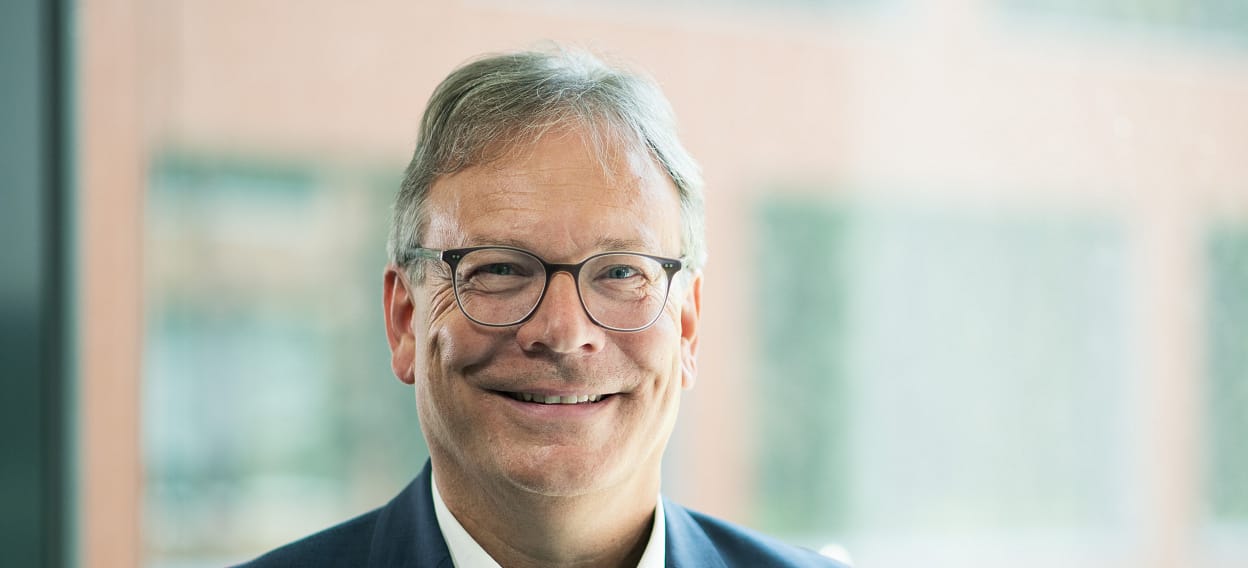
Andrea Simon – Head of Business Line Strategy, Evonik
Evonik may well be the market leader in the amino acid methionine, but the German chemical giant is not standing still. Its animal nutrition department is working hard on new innovations. This work focuses on sustainable solutions.
ANDREA SIMON - HEAD OF BUSINESS LINE STRATEGY AT EVONIK
Whatever the topic, there is a good chance that Andrea Simon and her team already have a vision and perhaps even a solution for it. In everything she does we see that, as the Head of Business Line Strategy, she has a sustainability mindset when it comes to products and services for animal health and animal feed. ’We are making an impact with sustainable solutions for meat, fish, milk and eggs. Evonik wide we want to complete our sustainability analysis end of 2020 with the goal to have at least 30 percent of our products allocated to the performance categories “Leader” (A++) or “Driver” (A+)’, Andrea claims.
This sustainability mindset is nice, but what has it delivered so far and what obstacles have you encountered along the way?
’Evonik Animal Nutrition has a strong track record in targeting sustainability. We have been among the first who provided Life Cycle Analyses for their amino acid products and developed feeding concepts which put reducing the environmental impact of animal protein production in the centre of the efforts. Our latest good example of successful innovation is probiotics, a new product group based on biotechnology. Probiotics are to avoid the use of antibiotics. However, sometimes the easy way for the customer is still the usage of antibiotic growth promoters or even therapeutic antibiotic treatment. Our nutritionists are conveying the message about alternative solutions to our customers. Feed producers might not always immediately see the benefit for their businesses. Here, we have to open up their perspective which includes that we have to promote the new products and solution concepts throughout the entire value chain.'
What does Evonik see as the greatest challenges for livestock farmers and animal feed producers?
‘Globally, we are talking about three enormous challenges: Antibiotic Free Animal Protein Production, Animal Welfare and the Ecologic Footprint of Animal Protein. While, at the same time, the world population is growing rapidly, especially in Africa and Asia. In combination with this, the protein requirement has risen from 50 to 70 grams per day, according to the World Health Organization. We already have viable, sustainable solutions in our portfolio and we are continuously working on improving the existing and developing additional ones.’
Can one express this transformation in figures?
‘We don't talk about antibiotic reduction in figures because consumers want it to go even further, so we are focusing on "antibiotic-free". And we go much broader with other issues than merely improving the carbon footprint. We really want to address the questions and have a positive impact while being transparent about the implementation of our mission – to offer sustainable solutions for animal protein production to guarantee food security worldwide at lowest overall environmental impact.’
What is your role in this?
‘I focus on the strategic roll-out of sustainability, close to the business. Where do we want to go? What do we do, and what not? How do we organize that? And how do we address it in the feed industry and the respective value chain? Sometimes it is not our customer, the feed producer or integrator who wants change, but the retailer, mainly driven by the demand of the consumer. We want to gain clear insight into those needs, and to understand and manage them better. In this way, one can have impact on the sustainability of the whole chain.’
This sounds good, but is it also financially feasible? How do you find the balance between sustainability and a revenue model?
‘You cannot escape the fact. If you want to be sustainable, you have to focus on that, even if this simultaneously involves a struggle to find the balance. This means that you have to do this well right from the start of a product or service development process. To achieve this, Evonik uses a sustainability analysis, with which we carefully check whether our products meet the criteria – if a product appears not to meet the requirements somewhere in development, it will not be included in the portfolio.’
You are working in an incredibly exciting time in which a lot is happening. How does this affect your work?
‘It is never boring here! There are so many topics and discussion points to tackle; we are already doing many things and there are others that we want to do in the future. Altogether quite a challenge. In terms of feed consumption, we are working on solutions with sustainable effects. For our work, it means that you must be able to explain this in plain language everybody understands. It is certainly a challenge for experts who are deeply involved in the subject. They sometimes forget that people who are less involved cannot follow their story. Clear communication skills is obviously a quality we look for in the skill set of new employees.’
What is the most important thing you have learned during your career?
‘I was born in Germany and trained as an engineer but having worked abroad for ten years made me realize that everyone has their own normal. In France and in the United States, I discovered that my normal is not someone else's. There are so many visions and ways to get somewhere. Your own way is not always the best or the most relevant. My experience is that everyone can contribute something meaningful from their own perspective. A plan actually improves through looking at it from different angles, but you have to be open to this.’
It sounds like diversity and inclusion are fairly high on the agenda.
‘Certainly, diversity is a big issue here. On my corridor alone, there are French, Danes, Indians and Chinese. The talent pools and the programme to support women getting ahead are also doing their jobs. When I started my career, there were only a few women around; that is different now. Diversity here creates an open and pleasant work atmosphere in which everyone tries to help each other and is highly team-oriented.’